
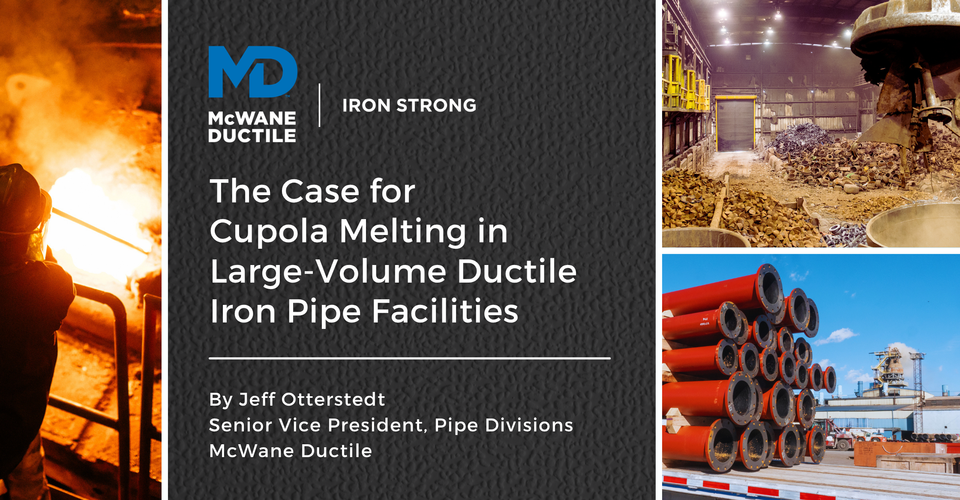
As foundries contemplate the transition from cupola melting to electric arc furnaces (EAFs) or induction melting furnaces (IMFs), the conversation often centers on profit margins and operational efficiency. Yet, for large-volume Ductile iron pipe producers, the challenges lie elsewhere: securing reliable raw materials and managing the unpredictability of energy supply, all while navigating the nuanced landscape of environmental impact. This #IronStrong blog explores why cupola melting remains a valuable asset in large-volume Ductile iron pipe production, examining its advantages in throughput, energy utilization, operational efficiency, and long-term manufacturing performance.
Reliability and Consistency
Cupola furnaces have long been the backbone of pipe production, delivering consistent melt quality and steady output.1 Their operational predictability is invaluable for facilities that must meet tight delivery schedules for customers across the country. This familiarity ensures that production rates remain high, without the disruptions that can accompany modern technologies.2
Material Sourcing Challenges
A critical issue for electric melting is sourcing pig iron and/or cast scrap—essential inputs for EAF and IMF operations. In the United States, pig iron is largely imported, making facilities vulnerable to supply chain interruptions, global market fluctuations, and increased transportation costs. Cast scrap is also hard to source, as most scrap dealers prefer to process cast in shredders.
Cupola melting, by contrast, offers flexibility in feedstock, allowing foundries to recycle a broader range of scrap materials and reduce dependency on imported pig iron. This adaptability is especially valuable in today’s uncertain supply environment.3
The choice between pig iron and scrap directly impacts the recycled content of Ductile iron pipe (DI pipe). Pig iron, derived from iron ore, is a primary raw material, and its use lowers the proportion of recycled material in the finished product. Scrap, on the other hand, allows manufacturers to maximize recycled content, supporting sustainability and resource conservation.4
Notably, McWane Ductile currently produces Ductile iron pipe with over 90% recycled content, a testament to its commitment to environmental stewardship and circular manufacturing. This high recycled content highlights the advantages of cupola melting, which enables the incorporation of diverse scrap materials and enhances resilience to material sourcing challenges.5-7 To find more specifics, I recommend reading these #IronStrong blogs:
Electric Supply and Curtailment Concerns
While EAFs rely on electricity, large-volume melting can expose producers to risks associated with grid instability. During periods of high consumption—such as summer heat waves—power companies may curtail supply to industrial users, resulting in production delays and potential contractual challenges for pipe suppliers. Cupola furnaces, fueled by coke or coal, are less susceptible to these disruptions, offering greater operational autonomy.8-9
Environmental Impact: Beyond the Fallacy
There is a widespread belief that electric melting is the greener option. However, this is an oversimplification. The true environmental impact of electric melting depends heavily on the region’s electricity sources. Where grids are powered by fossil fuels, the carbon footprint of IMFs and EAFs can be comparable to—or even exceed—that of cupola furnaces. The environmental advantage of electric melt options becomes evident only when renewable energy is prevalent and accessible.10
Cupolas have evolved in response to environmental regulations, with modern units equipped with state-of-the-art emission controls, scrubbers, and improved process management to reduce particulate and greenhouse gas output. Moreover, their ability to recycle a wide range of scrap materials contributes to resource conservation and waste minimization. The notion that cupolas are inherently dirtier ignores these technological advancements and fails to account for the upstream impacts of electricity production and raw material transport for electric-based melting.11-12
Neither melting method is universally superior from an environmental perspective. The most sustainable choice depends on local energy infrastructure, emissions management, and material sourcing.
Customer Impact and Operational Stability
By continuing to use cupola melting, Ductile iron pipe facilities can deliver reliable, high-quality products to customers, maintain production even during energy curtailments, and navigate material sourcing challenges with greater flexibility. The decision to transition should be guided by a holistic assessment of operational realities, not just assumptions about profit or environmental impact.
In sum, cupola melting continues to offer distinct advantages for large-volume Ductile iron pipe producers. It is not just about tradition; it is about resilience, adaptability, and a pragmatic approach to sustainability that ensures the needs of customers and the industry are met.
Need Assistance with Your Waterworks Project?
If you have any questions about your water or wastewater infrastructure project, your local McWane Ductile representative has the expertise to assist you. Many of our team members have managed small and large water utility systems, served at engineering consulting firms, and bring decades of experience solving field issues related to pipeline construction and operation. From design to submittal to installation, we strive to educate and assist water professionals throughout the water and wastewater industry.
Check Out All Our Digital Offerings
References
- Mishra, G.D. Ductile Iron through Cupola Furnace. GDM Technics. This paper documents modern cupola furnace performance, including high melt rates, consistent chemistry control, and applications in U.S. ductile iron pipe foundries.
- American Foundry Society (AFS) Cupola Committee. “The Resilient Future of Cupola Melting.” Modern Casting, 2025. Discusses the continued importance of cupola furnaces, noting they account for approximately 32% of U.S. iron production and remain essential for large-scale ductile iron melting operations.
- GDM Technics. Cupola Furnace Technical Paper. Provides technical analysis of modern cupola capabilities, including the ability to process contaminated, oxidized, zinc-bearing, and mixed scrap streams that may be unsuitable for induction furnaces.
- UK Good Practice Guide 58. Cupola Melting of Cast Iron. Government-supported guidance detailing the operational stability, scrap tolerance, and cost-efficiency advantages of cupola melting technology.
- Observatory of Economic Complexity (OEC). United States Pig Iron Imports, 2025–2026. Data showing annual U.S. pig iron imports exceeding $2.2 billion, with major supply sources including Brazil and Ukraine.
- Argus Media. “U.S. Pig Iron Imports Nearly Double.” 2024. Analysis of pig iron market volatility, geopolitical risks, and supply chain exposure affecting U.S. manufacturers.
- U.S. Geological Survey (USGS). Mineral Commodity Summaries: Iron and Steel, 2024. Provides data on domestic pig iron production and the U.S. industry's continued reliance on imported raw materials.
- Springer. “Power Utilization in Induction Furnace Controlled Melting.” 2025. Examines electrical demand management challenges, including peak demand charges, demand caps, and operational risks associated with induction melting systems.
- Foundry Management & Technology. “Induction Energy Management.” Technical discussion of high instantaneous power requirements and energy management considerations in electric melt shops.
- American Foundry Society (AFS) OnLive. “Carbon Footprint Comparison: Cupola vs. Electric Melting.” 2023. Presents lifecycle emissions comparisons between cupola and electric melting technologies, highlighting the influence of regional power generation sources.
- American Foundry Society (AFS). “The Resilient Future of Cupola Melting.” Modern Casting, 2025. Discusses how optimized cupola operations can achieve carbon dioxide emissions performance comparable to induction melting, depending on regional energy conditions.
- U.S. Environmental Protection Agency (EPA). AP-42 Compilation of Air Pollutant Emission Factors: Iron Foundries. Regulatory reference describing emissions sources, control technologies, and environmental considerations for iron foundry operations.