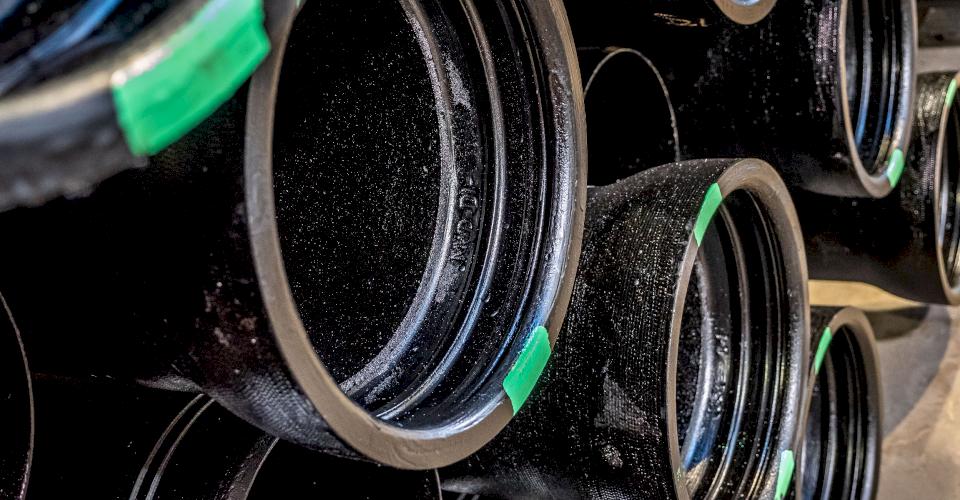
Although they may all look the same, every piece of Ductile iron pipe is unique in how it's manufactured.
Each pipe has identifying marks and labels that help the user identify the pipe and its intended use.
Each pipe also carries painted markings that help the installer by providing pipe length, indicating suitability for field cutting, and supporting proper installation.
What are McWane Ductile's specific pipe markings?
All Ductile iron pipe manufacturers use markings similarly to help customers select the right material for the project. This includes verifying the material is suitable for the intended application (i.e., water or sewer) and meeting project requirements stipulated by the owner/engineer for pipe class, lining, and exterior coating.
Because each manufacturer's colors may vary, we will explain how McWane Ductile applies these markings and describe their purpose and locations.
These markings or labels include:
- Spigot Stripes Used for Installation
- Green Paint Markings for “GFL” Pipe
- Blue Markings to Indicate “Zinc”
- Tick Marks Indicating Foundry Cuts to the Pipe
- The Pipe Label or Identification Sticker
- Special marking to Indicate Protecto 401™ Lined Pipe
- And the Indelible, Cast-in Information required by Standard
Spigot Stripes
These stripes are applied to the spigot or plain end (PE) of the pipe and provide both an alignment guide as well as a reference point to determine a pipe that is “FULLY HOMED" into the receiving bell.
Pipe manufactured as “Tyton® Joint,” such as manufactured by McWane Ductile and US Pipe, will have two even-width stripes applied. These stripes also assist in the deflection of the pipe after assembly.
NOTE: Take necessary deflection only after the pipe is fully homed.
To learn more about joint deflection and spigot stripes, check out our blog post with video: How Do Spigot Stripes Assist in the Assembly of Ductile Iron Pipe?
- Pro Tip: Pipe manufactured as Fastite Joint by American Ductile Iron Pipe will have only a single spigot stripe applied. Knowing this difference gives the user a quick way to identify the joint and which gasket to install in the bell.
Green Paint for “Gauged Full Length”
Any pipe marked with green paint at the bell face will denote Gauged Full Length or “GFL” pipe.
This is typically marked only for 14-inch and above and indicates that our quality assurance inspectors have determined these pipes are best suited for field cuts based on both outside diameter measurements and pipe ovality.

Note: Pipe 14 inches and larger that is not marked with a "green bell” may also be field-cut for assembly. The user would just need to perform some simple checks prior to cutting:
All pipe 12 inches and down is considered “Gauged Full Length,” but we recommend measuring the Outside Diameter of EVERY pipe before cutting and avoiding cuts closer than 24 inches from the face of the bell without measuring first. A retainer gland can also help you check pipe size and ovality before cutting. For more information on "How to Cut Ductile Iron Pipe to Length," check out our blog post and video.
Blue Paint for Zinc-Coated DI Pipe
Also marked on the bell face, the blue markings signify that the pipe has been received a coating of Zinc underneath the typical topcoat of the normal seal coat paint. The pipe typically carries a “Zinc” sticker, and this information will also be printed on the identification label.
Note: We recommend using zinc-coated DI pipe in areas where corrosion may be a concern. We also recommend encasing these pipes in V-Bio® polyethylene encasement. For more information on using zinc-coated pipe, please consult our Engineering and Technical Support Team for corrosion protection recommendations for Ductile iron pipe and the revised Design Decision Model (DDM) for buried pipelines.
Foundry Cuts
Some pipes may have visible white lines or “Tick” marks on the bell face. These marks denote that the pipe has been cut shorter than its standard nominal lay length at our facility. Each mark represents up to a 6-inch cut, with the maximum allowed by the ANSI/AWWA standard being 24 inches of trim, represented by four tick marks.
During a production run, our quality staff will periodically take samples from the plain end of a pipe as required by the Standard for physical testing. They may also find it appropriate to trim a pipe because of the condition of the plain end after manufacturing. As this is a crucial part of the joint make-up, our group is very particular about inspecting these cuts and re-beveling the plain end to facilitate smooth assembly in the field.

Identification Stickers
Typically located near the bell end of the pipe, the sticker describes all the pertinent information concerning the pipe, including:
- Pipe Size (Diameter)
- Pipe Class
- Joint
- Lining(s) and Coating
- Cast Date
- The appropriate accreditations our products carry
Labels may vary depending on the type and size of pipe ordered, as well as the foundry where it was manufactured.
Special “Red” Marking to Indicate Protecto 401™ Lined Pipe
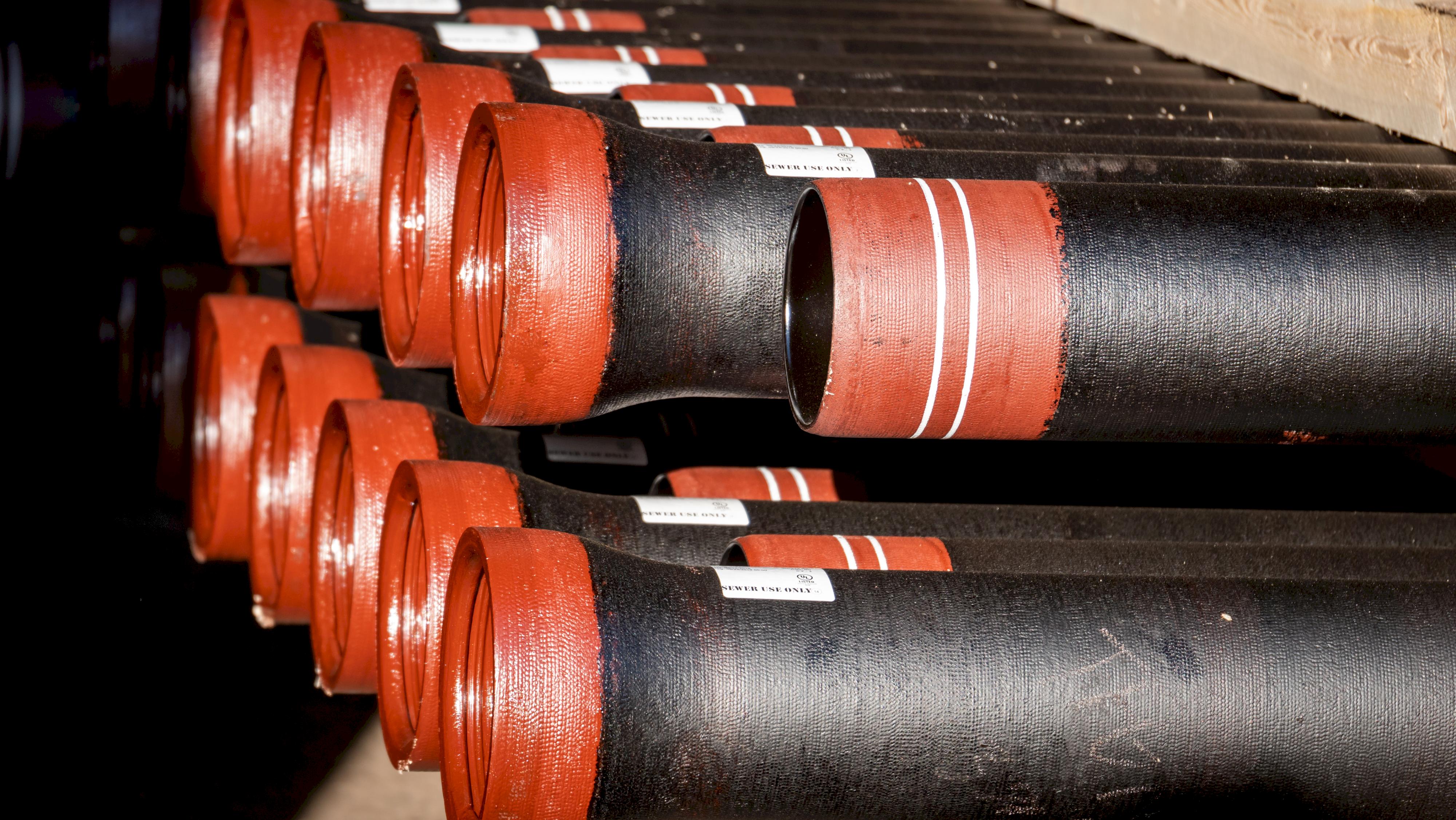
McWane utilizes Protecto 401 as its primary inside lining for sewer applications. As with other linings used in this application, it is not suitable for use in potable water distribution.
Therefore, to ensure this specially lined pipe is not inadvertently installed for water use, it is clearly marked with a red primer coating of Protecto 401 on both the bell and spigot ends. Often, the words “For Sewer Use Only” are also marked on the pipe.
Cast-in Information Required by Standard
By requirements of the ANSI/AWWA C151/A21.51 Standard, all ductile iron pipe must have the following information cast-in or stamped on the pipe in clearly legible markings on or near the bell: the manufacturer's mark, country where cast, year of production, and the letters “DI” or “DUCTILE”. The pipe diameter is also marked on the pipe in this manner.
Lastly, for complex installations such as fully restrained joint projects with TR Flex® pipe and fittings, or perhaps a treatment plant project, you may need to provide pipe that is Color-Coded or has Mark Numbers applied. These markings ensure the appropriate material is delivered and installed in a manner that corresponds with the line drawings or lay schedule developed for the project.
Final Thoughts
Hopefully this article has been helpful in providing insight into what the various markings on the pipe mean and why they are there. For additional information on pipe markings, please consult your local McWane Ductile Sales Representative.
Need Assistance With Your Waterworks Project?
McWane Ductile offers multiple services to our customers, extending far beyond manufacturing DI pipe. From estimating to design, and from production to installation, we take pride in educating and supporting water professionals across the industry.
Check out all our digital offerings: